

Sysmex XN-9100
Sysmex Corporation. Japan

Automated line
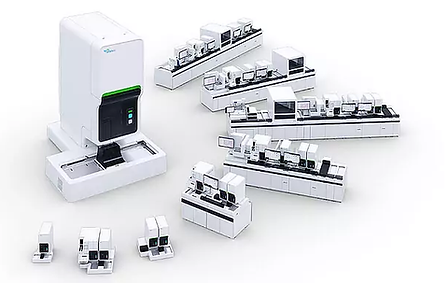
Automated hematology analysis line with sample sorting functionality and a module for smear preparation and staining
The XN-9100 system comprises at least three hematology analysis modules and a slide preparation and staining module, integrated into a single automated line.
All integrated system components are linked by a common control station, the Extended IPU, which ensures the line operates as a single, cohesive unit.
The full spectrum of technologies and diagnostic capabilities of the XN series can be implemented on each of the hematology analysis modules included in the system.
An integrated system of rules provides technical and biomedical validation of analysis results, which increases testing efficiency, reduces the volume of smear analyses, and shortens the time it takes for results to become available to the physician.
DESIGNED FOR VERSATILITY
XN-9100 Compact Integration: this configuration can include up to 9 modules, such as hematology analysis modules, the SP-50 slide preparation and staining module, and the optional DI-60 digital imaging module. The XN-9100 Compact Integration features a return track on the operator side to transport sample tubes to the exit area. This configuration is ideally suited for hematology testing in settings with medium to high workloads and consistent sample types, such as outpatient clinics or private laboratories.
XN-9100 Sorting & Archiving: In this configuration, the system includes a tube-sorting module in addition to the XN and SP hematology analysis modules. Depending on the required sorting speed and volume, the sorting component can be configured as either the TS-10 (500 samples/hour) or the TS-10 Up (1,000 samples/hour). This configuration is suitable for laboratories that handle individual samples and require sorting prior to archiving or performing additional analyses on EDTA tubes (such as ESR or HbA1c testing).
XN-9100 Workload Balance: a configuration ideally suited for laboratories that handle various sample types and require initial sample sorting prior to analysis. A sorting module (TS-10 or TS-10 Up) is installed at the beginning of the workflow. Samples are sorted before analysis, which optimizes the workload across each system module and ensures full utilization of the capacity of every module. To transport tubes to the exit point, the configuration includes a return line located at the rear of the instrument.
XN-9100 Maximum Workload: a configuration designed for the highest workloads, handling volumes exceeding 2,000 samples per day. This configuration features two sample input streams: a primary stream for routine screening, and a separate stream for pathological samples or those requiring specialized tests (e.g., reticulocytes, WPC, etc.). This setup consists of two XN-9100 units connected via a high-throughput sorter (TS-10 Up).
Configurations
XN-9100 Compact Integration: this configuration can include up to 9 modules, such as hematology analysis modules, the SP-50 slide preparation and staining module, and the optional DI-60 digital imaging module. The XN-9100 Compact Integration features a return track on the operator side to transport sample tubes to the exit area. This configuration is ideally suited for hematology testing in settings with medium to high workloads and consistent sample types, such as outpatient clinics or private laboratories.
XN-9100 Sorting & Archiving: In this configuration, the system includes a tube-sorting module in addition to the XN and SP hematology analysis modules. Depending on the required sorting speed and volume, the sorting component can be configured as either the TS-10 (500 samples/hour) or the TS-10 Up (1,000 samples/hour). This configuration is suitable for laboratories that handle individual samples and require sorting prior to archiving or performing additional analyses on EDTA tubes (such as ESR or HbA1c testing).
XN-9100 Maximum Workload: a configuration designed for the highest workloads, handling volumes exceeding 2,000 samples per day. This configuration features two sample input streams: a primary stream for routine screening, and a separate stream for pathological samples or those requiring specialized tests (e.g., reticulocytes, WPC, etc.). This setup consists of two XN-9100 units connected via a high-throughput sorter (TS-10 Up).
XN-9100 Workload Balance: a configuration ideally suited for laboratories that handle various sample types and require initial sample sorting prior to analysis. A sorting module (TS-10 or TS-10 Up) is installed at the beginning of the workflow. Samples are sorted before analysis, which optimizes the workload across each system module and ensures full utilization of the capacity of every module. To transport tubes to the exit point, the configuration includes a return line located at the rear of the instrument.


Configurations
XN-10 Automated Hematology Analysis Module:
1. Basic CBC+DIFF mode
2. Optional diagnostic channels:
RET channel (analysis of reticulocytes and reticulocyte parameters)
PLT-F channel (fluorescent platelet analysis, including assessment of the immature platelet fraction)
BF channel (cytological analysis of body fluids)
XN-20 Automated Hematology Analysis Module:
1. Basic mode: CBC+DIFF, RET channel (analysis of reticulocytes and reticulocyte parameters), WPC channel (for the diagnosis of neoplastic processes and the enumeration of hematopoietic precursor cells)
2. Optional diagnostic channels: PLT-F channel (fluorescent platelet analysis, including assessment of the immature platelet fraction)
BF channel (cytological analysis of body fluids)
SP-50 Automatic Smear Preparation and Staining Module
DI-60 module for digital imaging and morphological analysis of blood cells and body fluids (optional)
TS-10 and TS-10Up Automatic Sample Sorting Module
CHARACTERISTICS
Measurement principle
CBC+DIFF mode parameters (standard for XN-10/20)
RET channel parameters (optional for XN-10 and standard for XN-20)
PLT-F channel parameters (optional for XN-10 and XN-20)
WPC Channel Parameters (base for XN-20)
- WBC DIFF/RET/PLT-F/WPC: Flow cytometry
RBC/PLT: Hydrodynamic focusing with impedance method
HGB (hemoglobin): Cyanide-free SLS method
Smear preparation: Wedge method
Smear staining protocols: Romanowsky-Giemsa, Wright-Giemsa, Wright
Image analysis system (optional): Digital microscopy with image analysis using artificial neural networks
WBC, NRBC%, NRBC#, RBC, HGB, HCT, MCV, MCH, MCHC, PLT, RDW-SD, RDW-CV, MicroR%, MacroR%, PDW, MPV, P-LCR, PCT, NEUT%, NEUT#, LYMPH%, LYMPH#, MONO%, MONO#, EO%, EO#, BASO%, IG#
Optional: Extended Inflammation Parameters license: NEUT-GI, NEUT-RI, RE-LYMP%, RE-LYMP#, AS-LYMP%, AS LYMP#
Optional: TNC, TNC-C, TNC-D, WBCC, WBC-D, NE-SSC, NE-SFL, NEFSC, HFLC#, HFLC%
RET%, RET#, IRF, LFR, MFR, HFR, RET-He, RBC-He, Delta-He, HYPO-He%, HYPER He%, PLT-O
Additional: FRC#, FRC%, RPI, RBC-O, HGB O, MCHC-O
PLT-F, IPF, IPF#
Highly specific marker for neoplastic processes
Optional: stem cell count (XN Stem Cells licence): HPC%, HPC#
BF-channel parameters (optional for XN-10 and XN-20)
Main: WBC-BF, RBC-BF, MN%, MN#, PMN%, PMN#, TC-BF#
Additional: HF-BF#, HF-BF%, NE-BF#, NE BF%, LY-BF#, LY-BF%, MOBF#, MO-BF%, EO-BF#, EO-BF%, RBC-BF-2
Throughput capacity
XN-10/XN-20 automated hematology analysis module: 100 samples per hour in CBC+DIFF mode (with 5 modules integrated into a line, the total throughput reaches 500 samples per hour)
SP-50 automated blood smear preparation and staining module
Standard mode — 35 stained smears per hour
High-throughput mode (high-throughput license) — 75 stained smears per hour
Sample aspiration volume
Hematology analysis module (XN-10/20):
88 µL of venous or capillary blood with EDTA for CBC+DIFF, CBC+DIFF+RET, and CBC+DIFF+RET+PLT-F modes
88 µL of a biological fluid sample for the BF analysis mode
Device memory
Complete test results from 100,000 samples
100,000 patient information records
Quality control (QC) data: 99 files (300 charts per file); X-bar control charts (Levey-Jennings charts) – 94 files (300 charts per file); X-barM control charts – 5 files (300 charts per file)
5,000 records of reagent replacements
Quality Control
XN CHECK L1, XN CHECK L2, XN CHECK L3: Material (3 levels) for quality control of all parameters in CBC+DIFF+RET mode. Pack size: 3 ml per level.
XN Check BF: Material (2 levels) for quality control of all parameters in CBC+DIFF+RET mode. Pack size: 3 ml per level.
Reagents
RFID (Radio Frequency ID) tags for hands-free management of cartridge-related information
Concentrated reagent formulation minimizes changes to reagent properties and the need for reagent handling, while improving reagent inventory management
Option to store reagents on a platform located beneath the instrument
Dimensions
3,378 x 1,543 x 1,150 mm / 879 kg (for a system consisting of 3 XN-10/XN-20 modules, 1 CV-50 module, 1 WG 50 unit, 1 CV-55 module, 1 WG-55 unit, 1 SP-50 module, 1 CV-65 module, 1 WG-65 unit, 2 ST-40 modules, 1 BT-40 module, and 3 WG 40 units)